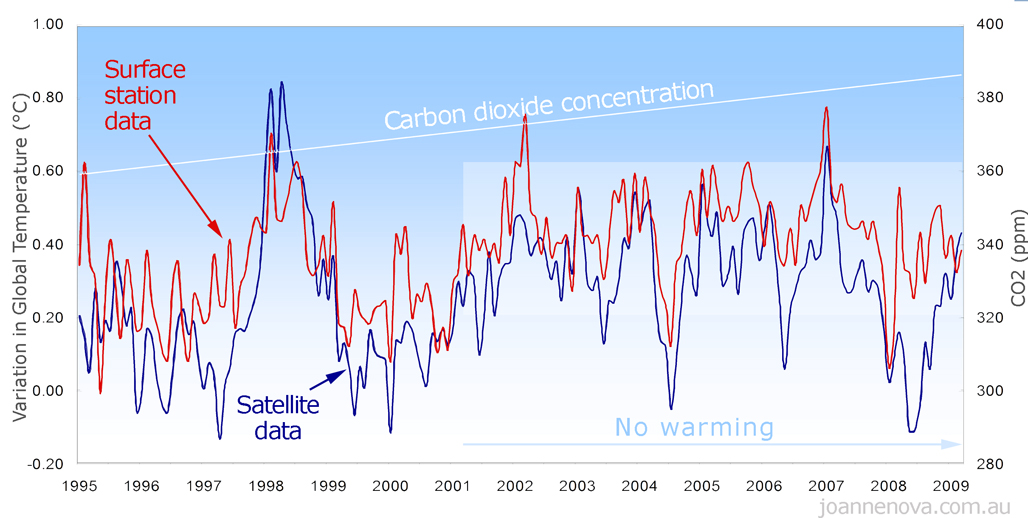
Sorry for the late post. Life is a little busy right now.
Here is a link to a video produced by the Competitive Enterprise Institute. CEI Senior Fellow Marlo Lewis presents straight talk about global warming in his film
Policy Peril: Why Global Warming Policies Are More Dangerous Than Global Warming Itself.
See it here...
Wednesday, August 26, 2009


Wednesday, August 19, 2009
Al Gore's Snow Job
Nashville, the home of leading global warming prophet Al Gore, has enjoyed the coolest July 21 on record. Doh!
Read more...
Read more...
Wednesday, August 12, 2009
Bye Bye ETS. For now!
The Rudd/Wong ETS legislation faces certain defeat in the Senate today. Thank God!
This stupidity that will cost tens of thousands of jobs and billions of dollars will do absolutely nothing for the climate, pollution or anything else.
An ETS should be seen for what it is.
An exuse to implement a new tax in the guise of saving the world.
A very good summary is provided here.
Read more...
Thanks to Andrew Bolt
This stupidity that will cost tens of thousands of jobs and billions of dollars will do absolutely nothing for the climate, pollution or anything else.
An ETS should be seen for what it is.
An exuse to implement a new tax in the guise of saving the world.
A very good summary is provided here.
Read more...
Thanks to Andrew Bolt
Sunday, August 9, 2009
Why a New ETS?
Here is some very clear thinking around the stupidity of the Rudd Government's Carbon trading policy.
Thanks to Quadrant Online.
Read more...
Thanks to Quadrant Online.
Read more...
Sunday, August 2, 2009
Answering 3 simple questions
by Willie Soon and David R. Legates
Why is it so difficult to get straightforward answers to three simple questions about climate change?
Senator Steve Fielding, an engineer who understands the distinction between facts and fanciful computer models, recently posed three questions regarding climate change to Minister Penny Wong.
The Minister, through her Department of Climate Change, provided answers to those questions based largely on advice from Professor Penny Sackett (Chief Scientist of Australia) and Professor Will Steffen (ANU Climate Research Centre). The “answers” often evaded the issues raised by Senator Fielding, and mostly discussed peripheral, if related, issues.
The answers also shifted the usual goalposts, arguing, for example, that global average atmospheric temperature was not a desirable measure of global warming – despite its consistent use by the Intergovernmental Panel on Climate Change (IPCC) for more than 15 years. Rather, the Department now wants to use ocean heat content as their prime measure.
A measured scientific audit of the Minister’s replies to the three climate questions was provided later by Senator Fielding’s four independent scientific advisers.
Meanwhile, The Australian published an independent attempt to answer Senator Fielding’s questions by Professor Neville Nicholls. Professor Nicholls’ answers are as misleading as the Department of Climate Change’s were beside the point.
Read more...
Why is it so difficult to get straightforward answers to three simple questions about climate change?
Senator Steve Fielding, an engineer who understands the distinction between facts and fanciful computer models, recently posed three questions regarding climate change to Minister Penny Wong.
The Minister, through her Department of Climate Change, provided answers to those questions based largely on advice from Professor Penny Sackett (Chief Scientist of Australia) and Professor Will Steffen (ANU Climate Research Centre). The “answers” often evaded the issues raised by Senator Fielding, and mostly discussed peripheral, if related, issues.
The answers also shifted the usual goalposts, arguing, for example, that global average atmospheric temperature was not a desirable measure of global warming – despite its consistent use by the Intergovernmental Panel on Climate Change (IPCC) for more than 15 years. Rather, the Department now wants to use ocean heat content as their prime measure.
A measured scientific audit of the Minister’s replies to the three climate questions was provided later by Senator Fielding’s four independent scientific advisers.
Meanwhile, The Australian published an independent attempt to answer Senator Fielding’s questions by Professor Neville Nicholls. Professor Nicholls’ answers are as misleading as the Department of Climate Change’s were beside the point.
Read more...
Thursday, July 30, 2009
Green Jobs con revealed!
According to a report by a Spanish university, for every 4 jobs created in the Renewable Energy Sector, 9 are lost.
Spain is headed for a 20% unempoyment rate! That's what we face here if Rudd/Wong and Co. get their way.
Read more...
Spain is headed for a 20% unempoyment rate! That's what we face here if Rudd/Wong and Co. get their way.
Read more...
Do you have a beef with the ETS? You will!
If your house is wired up for power then every electrical appliance will be attached to a power generator which in all likelihood will pay a tax and that tax will be passed on to you, the consumer.
The price of toasting bread has just gone up, the price of ironing the school uniform has just gone up, the price of vacuuming the living room has just gone up and the price of watching the Sunday afternoon game on TV has just gone up.
If you’re associated with the consumption of food, that’s either grown with the use of carbon intensive processes, or if you like to eat beef, mutton or lamb, which involves the emission of methane and is apparently a super form of carbon, then under Mr Rudd’s proposal, you’ll potentially have to pay for the privilege.
Put simply, a single beast, which ends up on our supermarket shelves as steak, roast, mince or sausages, emits about 70 kilograms of methene and according to the Kyoto protocol this has to be multiplied by 21 which means that each beast is responsible for emitting around a tonne and a half of carbon.
Utilising NAB modelling on the price of a carbon permit, a tonne and half of carbon, multiplied by about $50, is equivalent to an additional cost to the farmer of approximately $75 dollars per beast per year.
$75 dollars per beast per year = no beef industry in Australia!
If the consumer wants to eat beef and can afford to pay for it then you will be buying it from a country that doesn’t have an ETS.
The price of beef in Australia will be above the price paid in other countries that don’t have a beef industry which will result in you paying better than $100 dollars for a prime cut roast.
Quite obviously the quality of the Australian standard of living, as reflected in our diet, will be reduced.
When it comes to lamb and mutton, sheep emit around 10 kilograms of methane, so using the same formula; this means around 210 kilograms of carbon per year, per sheep which equates to Australian sheep farmers being slugged about $10 per sheep annually and this will ultimately drive sheep meat out of the market.
So, if you decided to have a lamb roast for dinner this Sunday, which the gentleman in the car giving me a lift today said he was planning to do, then expect to pay almost $100 dollars at the butcher for it.
Read more...
The price of toasting bread has just gone up, the price of ironing the school uniform has just gone up, the price of vacuuming the living room has just gone up and the price of watching the Sunday afternoon game on TV has just gone up.
If you’re associated with the consumption of food, that’s either grown with the use of carbon intensive processes, or if you like to eat beef, mutton or lamb, which involves the emission of methane and is apparently a super form of carbon, then under Mr Rudd’s proposal, you’ll potentially have to pay for the privilege.
Put simply, a single beast, which ends up on our supermarket shelves as steak, roast, mince or sausages, emits about 70 kilograms of methene and according to the Kyoto protocol this has to be multiplied by 21 which means that each beast is responsible for emitting around a tonne and a half of carbon.
Utilising NAB modelling on the price of a carbon permit, a tonne and half of carbon, multiplied by about $50, is equivalent to an additional cost to the farmer of approximately $75 dollars per beast per year.
$75 dollars per beast per year = no beef industry in Australia!
If the consumer wants to eat beef and can afford to pay for it then you will be buying it from a country that doesn’t have an ETS.
The price of beef in Australia will be above the price paid in other countries that don’t have a beef industry which will result in you paying better than $100 dollars for a prime cut roast.
Quite obviously the quality of the Australian standard of living, as reflected in our diet, will be reduced.
When it comes to lamb and mutton, sheep emit around 10 kilograms of methane, so using the same formula; this means around 210 kilograms of carbon per year, per sheep which equates to Australian sheep farmers being slugged about $10 per sheep annually and this will ultimately drive sheep meat out of the market.
So, if you decided to have a lamb roast for dinner this Sunday, which the gentleman in the car giving me a lift today said he was planning to do, then expect to pay almost $100 dollars at the butcher for it.
Read more...
Subscribe to:
Posts (Atom)